
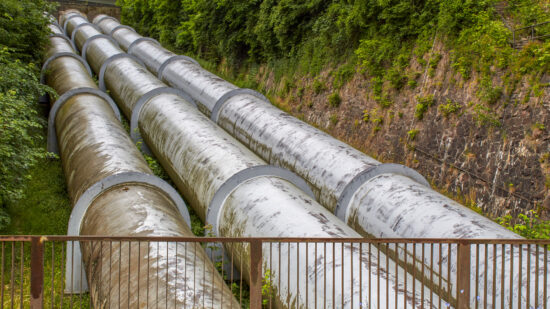
A federal judge in Michigan has affirmed a $383 million jury verdict against Toshiba for its work on the Ludington Pumped Storage Hydro plant. The case involves a project to overhaul the 50-year-old plant that uses electricity during periods of low demand to pump water into a reservoir. During periods of high demand (i.e., during the day), water is released from the reservoir through hydroelectric turbines that generate over 300 megawatts of electricity. The plant, located on the shores of Lake Michigan, is one of the largest pumped storage projects in the world.
The owner paid Toshiba American Energy Systems over $500 million to overhaul and upgrade the plant’s six units, which reopened between 2015 and 2019. The contract provided that Toshiba would return the plant as nearly to new condition as possible and allow the plant to operate with a minimum 30-year service life with only minimal routine maintenance. Within a few years of reopening, the owner allegedly observed degraded metal in two of the units during a periodic inspection. In 2022, the owner filed suit claiming that it could only operate two of the units approximately 50 hours per year due to Toshiba’s allegedly defective work. Among other alleged defects, the owner claimed that Toshiba improperly removed certain stainless-steel components, selected unsuitable replacement materials, and used construction methods that caused excessive stress and cracking. The owner sought to recover over $800 million in damages and prejudgment interest. We blogged about the case before trial last fall when the court ruled on various dispositive motions.
The case proceeded to trial before a Michigan jury that returned a verdict in favor of the utility company in the amount of $383 million (in addition to stipulated liquidated damages of $11 million). Toshiba moved to set aside the jury’s verdict claiming it was excessive and against the weight of the evidence. Toshiba also argued that the jurors, as utility ratepayers, were not financially disinterested, and that the trial court improperly admitted certain damages evidence. The court rejected all of Toshiba’s arguments in a 38-page decision released last month. As to Toshiba’s claims that the utility had not adequately proved its damages, the court repeated the familiar refrain that the amount of damages need only be proven with reasonable certainty and that “[m]athematical precision is not required.”
A copy of the court’s opinion in Consumers Energy Co. et al. v. Toshiba America Energy Systems Corp. et al., 2026 WL 2906537, No. 22-10847 (E.D. Mich. Sept. 28, 2026), is available here.